
Milița Petrașcu
Milița Petrașcu (born Melania Nicolaevici; 31 December 1892, Chișinău – 25 January 1976, Bucharest) was a Romanian sculptor of the interwar avant-garde and a pupil of Constantin Brâncuși. She made the fireplace in the salon of the Tătărescu House and the door frames. It was also she who recommended Brâncuși to Arethia Tătărescu for the heroes’ monument at Târgu Jiu.
Life and training
Melania Nicolaevici was born in Chișinău on 31 December 1892.1 The Romanian Academy’s Dicționarul sculptorilor din România (Dictionary of Sculptors in Romania) gives the year 1888, with a question mark.2
Her training took her through three artistic capitals:
- Moscow, 1907–1908. She studied at the Stroganov School, then letters and philosophy in Saint Petersburg.
- Munich, 1910–1911. By her own account, it was there that she met Kandinsky and Jawlensky.
- Paris. She attended Henri Matisse’s studio.
The lessons with Antoine Bourdelle, which are sometimes mentioned, are not attested by documents.2 She also signed her first works Militza Curie, after the name of her first husband.2
Brâncuși’s pupil (1919–1923)
She met Constantin Brâncuși in 1919, at the Salon des Indépendants in Paris. Between 1919 and 1923 she worked in his studio, and she considered herself his pupil and disciple. The Academy’s dictionary sums it up: “she was Brâncuși’s pupil for four years”.2 They remained friends until the sculptor’s death in 1957.3
She returned to his studio in 1927.4 The claim that sometimes circulates, that she worked “almost a decade” in Brâncuși’s studio, is not supported by sources. The documented period is 1919–1923, with a return in 1927.
In 1925 she married Emil Petrașcu (1890–1967) and settled in Bucharest.1
In the interwar avant-garde
In Bucharest she exhibited with the groups Contimporanul, Grupul nostru and Criterion, the core of Romanian modernism between the wars.2 She also exhibited abroad:
- in 1927, in Paris, at the Briand Robert Gallery;
- in 1933, at the exhibition of futurist art in Rome;
- in 1938, at the Venice Biennale.2
Her works include the bust of Alexandru Odobescu in Cișmigiu Gardens and the portrait of Constantin Brâncuși, a bust placed in Dorobanți Square in 2001. She also made sgraffito granite panels for houses designed by Marcel Iancu.2
She received:
- in 1939, the “Elena and Gh. Vlasto” Prize of the Romanian Academy;
- in 1942, the Order of Cultural Merit;
- in 1972, the Grand Prize of the Union of Fine Artists.21
Târgu Jiu: the mausoleum and the recommendation of Brâncuși
The link with the Tătărescu family runs through Gorj. The National League of Gorj Women, led by Arethia Tătărescu, entrusted her with the funerary monument of the heroine Ecaterina Teodoroiu. The Mausoleum of Ecaterina Teodoroiu in Târgu Jiu was unveiled on 8 September 1935, in the presence of King Carol II.5 Some sources give the year 1936, but the institutional sources indicate 1935.56 It is a sarcophagus of Italian travertine, 2.90 m long, 1.60 m wide and 2.10 m high. The bas-reliefs show scenes from the heroine’s life. The monument was restored in 2018–2019.7
The League then asked her to build the monument dedicated to all the heroes of Gorj as well. Milița Petrașcu declined and said that her mentor, Constantin Brâncuși, was better suited to this work.6 On her advice, Arethia Tătărescu invited Brâncuși in 1934.8 On 11 February 1935, Brâncuși replied to the sculptor (“Dear Madame Patrașcu…”) and thanked “Mrs Tătărascu”.9 This exchange of letters gave rise to the Heroes’ Way Monumental Ensemble (Calea Eroilor), with the Endless Column, the Gate of the Kiss and the Table of Silence. For how the League donated the works to the town, see the 1937 letter.
The works in the Tătărescu House
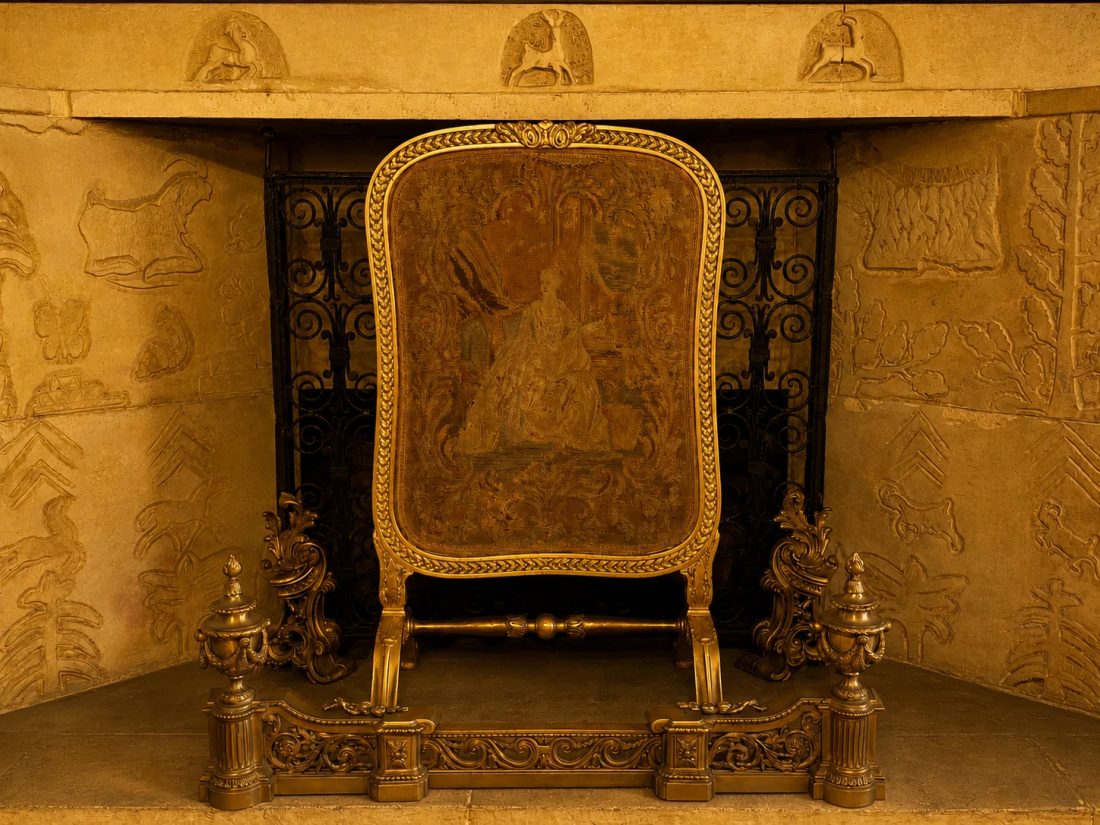
The architect Mădălin Ghigeanu studied the house’s building permit file. According to him, the salon is given “an apse that encloses the fireplace made by Milița Pătrașcu”. The fireplace is “impeccably made […] in a modernism with Neo-Romanian elements”. She also made the door frames.10 There is also a period photograph in which the Tătărescu couple stand in front of the fireplace.10
Sanda Tătărescu-Negropontes, the family’s daughter, remembered her like this: “she was a very good friend of my mother’s and left her mark on our house”.10
The fireplace in the anteroom of Gheorghe Tătărescu’s study has a peacock decoration. The current owners also attribute it to Milița Petrașcu, but her signature has not been found on it.11 The sources do not state the material the fireplaces are made of.
Brâncuși and the Tătărescu House
No art-history source documents a work made by Constantin Brâncuși for the Tătărescu House. The house’s link with Brâncuși is real, but it runs through two women:
- Arethia Tătărescu, who commissioned the Târgu Jiu ensemble from him;
- Milița Petrașcu, his pupil, who worked in the house and recommended him for the commission.
The pieces by Milița Petrașcu preserved in the salon are therefore the closest trace of Brâncuși’s school in the Tătărescu House.
Notes and sources
-
„Milița Petrașcu”, Romanian-language Wikipedia. ro.wikipedia.org ↩ ↩2 ↩3
-
Ioana Vlasiu (coord.), Dicționarul sculptorilor din România [Dictionary of Sculptors in Romania], vol. II, Editura Academiei Române, Bucharest, 2012, pp. 216–218. PDF, arhiva-brezianu.ro ↩ ↩2 ↩3 ↩4 ↩5 ↩6 ↩7 ↩8
-
„Milița Petrașcu, eleva lui Brâncuși” [Milița Petrașcu, Brâncuși’s pupil], Radio România Internațional. rri.ro ↩
-
„O personalitate pe zi: sculptorița Milița Petrașcu” [A personality a day: the sculptor Milița Petrașcu], Agerpres, 31 December 2022. agerpres.ro ↩
-
„80 de ani de la inaugurarea Mausoleului Ecaterinei Teodoroiu” [80 years since the inauguration of the Mausoleum of Ecaterina Teodoroiu], Monumente Oltenia. monumenteoltenia.ro ↩ ↩2
-
„Constantin Brâncuși — 63 de ani de la trecerea sa în eternitate” [Constantin Brâncuși — 63 years since his passing into eternity], Centrul Brâncuși, Târgu Jiu. centrulbrancusi.ro ↩ ↩2
-
„Mausoleul Ecaterina Teodoroiu” [The Ecaterina Teodoroiu Mausoleum], Romanian-language Wikipedia. ro.wikipedia.org ↩
-
„#AnulBrâncuși: Ansamblul Monumental «Calea Eroilor» de la Târgu Jiu” [#BrâncușiYear: the “Calea Eroilor” Monumental Ensemble at Târgu Jiu], Agerpres, 19 May 2026. agerpres.ro ↩
-
„Ansamblul monumental de la Târgu Jiu” [The monumental ensemble at Târgu Jiu], Historia. historia.ro ↩
-
Interview with architect Mădălin Ghigeanu about the Tătărescu House, B365, 2022. b365.ro ↩ ↩2 ↩3
-
„Misterul seifului imposibil de deschis din vila Gh. Tătărescu” [The mystery of the safe that cannot be opened in the Gh. Tătărescu villa], B365, 26 January 2026. b365.ro ↩
The people and the era of the Tătărescu House
- Biography Arethia Tătărescu The Great Lady of Gorj: the Gorj Women’s League, the commission to Brâncuși and the house on Polonă Street.
- Document Arethia Tătărescu’s letter to the Târgu Jiu town hall (1937) The 1937 letter in which the Gorj Women’s League gave the town Brâncuși’s column and gate. Full transcription.
- Art Constantin Brâncuși and the Tătărescu family Arethia’s invitation, Milița Petrașcu’s role, the summers at Poiana and the letters lost in 1950.
- Architecture The architects Alexandru Zaharia and Ion Giurgea The two architects of the house, which received its building permit in 1935, and the Mediterranean style of interwar Bucharest.
- Biography Gheorghe Tătărescu Twice Prime Minister of Romania, King Carol II’s trusted man, arrested in 1950.
- The era Carol II and interwar Bucharest Carol II’s reign, the Tătărescu government and the buildings that changed the capital in the 1930s.
- Mysteries The unopened safe of the Tătărescu House The Fichet safe in the Prime Minister’s study, closed for decades: what is known, what is legend, how to date it.
- The house The history of Vila Tătărescu From 1935, through nationalisation, to the restoration of 2024.
See the house for yourself
The Art. History. Experience. guided tour takes you through the salons where the Tătărescu family lived.