
Arethia Tătărescu
Arethia Tătărescu (née Piteșteanu; 16 September 1889, Bucharest – 8 May 1968, Bucharest) was the president of the National League of Gorj Women and the wife of Prime Minister Gheorghe Tătărescu. She is called “the Great Lady of Gorj”. The League she led commissioned Constantin Brâncuși to make the heroes’ monument in Târgu Jiu and donated the Endless Column and the Gate of the Kiss to the town. In Bucharest she built the house at 19 Polonă Street, which received its building permit in 1935 and is known today as the Tătărescu House.
Origins and education
Arethia Piteșteanu was born in Bucharest on 16 September 1889.12 Her father, Gheorghe Piteșteanu, owned agricultural estates and came from a family of boyars from Argeș.13 She was orphaned at the age of eight. She then went to Belgium with her grandmother and her brothers, Gheorghe and Alexandru.1
In Brussels she graduated from the Royal Conservatory, in piano. Her daughter, Sanda, later said that her mother had completed it “because that was what grandmother wanted”.1 After returning to Romania, she reportedly taught piano at the Music High School in Bucharest.34
Marriage
In the summer of 1916, at Tismana, she met Gheorghe Tătărescu, a lawyer who was then a lieutenant at the front. They married the same year, in Craiova.13 They had two children:
- Sanda, born on 15 August 1919 in Târgu Jiu. She was a National Liberal Party (PNL) senator in the 1990–1992 legislature and died in 2009.5
- Tudor, four years younger than his sister. He died in Paris in 1955.63
Gheorghe Tătărescu would twice become Prime Minister of Romania, in 1934–1937 and in 1939–1940.
The National League of Gorj Women
In 1921, Arethia Tătărescu took over the leadership of the National League of Gorj Women.17 Formally, the organisation was the Gorj section of the National League of Romanian Women.8 The League ran a weaving school and workshop in Târgu Jiu, in a new building on the Jiu embankment. In the 1928–1929 school year, 65 pupils worked there, at 15 large embroidery frames.48
The League’s carpets and costumes won first place in the competitions of the “Țesătoarea” (“The Weaver”) society in 1929–1930.4 They were also exhibited abroad: in Barcelona in 1930, then in Paris in 1937, in New York in 1939 and at the Milan Triennale in 1940.43
The League raised money mainly through exhibitions of folk art. The exhibition “Munca noastră românească” (“Our Romanian Work”) opened on 13 May 1937, in the presence of King Carol II.4 It was also the League that rescued from ruin the house where the heroine Ecaterina Teodoroiu was born, at Vădeni.1 For the heroine’s grave, it commissioned the Ecaterina Teodoroiu Mausoleum, sculpted by Milița Petrașcu. The mausoleum was unveiled on 8 September 1935, in the presence of the King.9
The Târgu Jiu ensemble
The League’s best-known work remains the monument to the Gorj heroes who fell in the First World War. In 1934, Arethia Tătărescu asked Milița Petrașcu for advice. The sculptor recommended her own teacher, Constantin Brâncuși, and Arethia invited him to create the monument.10 On 11 February 1935, Brâncuși accepted, in a letter to Milița Petrașcu: “I cannot tell you how happy I would be if I could make something back home in our Country”.11
Timeline of the work:
- June 1937. Brâncuși comes to Romania. The monument will be “an endless column”.11
- September 1937. The column is cast at the Central Workshops in Petroșani, under the direction of the engineer Ștefan Georgescu-Gorjan.10
- 20 October 1937. The Târgu Jiu town hall registers the League’s letter, signed by Arethia Tătărescu. The League gives the town “a column and a stone portal, works of the great sculptor Brâncuși” and provides 750,000 lei for the expropriations needed for Calea Eroilor (the Heroes’ Way).12
- 7 November 1937. Patriarch Miron Cristea consecrates the Church of the Holy Apostles Peter and Paul, built by the League on the same avenue. Brâncuși is the guest of honour.4
- 12 November 1937. The town council accepts the donation and the name “Calea Eroilor” (“the Heroes’ Way”).12
- 27 October 1938. The League hands over the “Column of Gratitude” and the “Portal” to the town, and the ensemble is inaugurated.1213 It is not known for certain whether Brâncuși was present. The head stonemason, Ion Alexandrescu, stated that the sculptor was absent.14
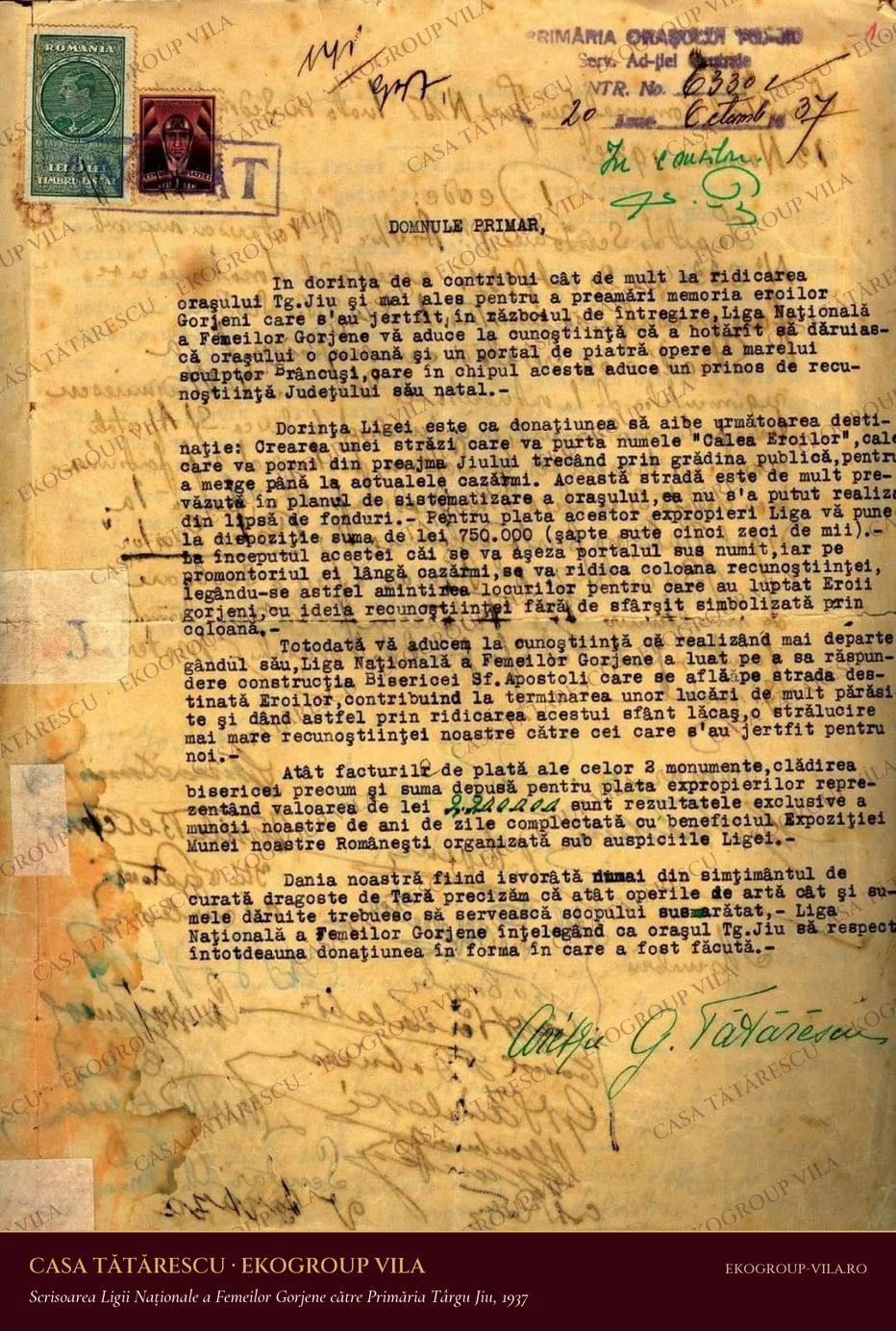
By October 1938, the League had spent 2,436,275 lei on the church, the expropriations, the portal and the column.13 Most of the cost of the Column was borne by the “Petroșani” Company, and Brâncuși refused to be paid.1315 The Table of Silence, the third piece of today’s ensemble, appears neither in the letter of donation nor in the handover record.12
Arethia’s connection with Brâncuși continued during the war years. In 1943 she was sending him food in Paris.14 On 27 July 2024, UNESCO inscribed the Brâncuși Monumental Ensemble of Târgu Jiu on the World Heritage List.16
The house at 19 Polonă Street
Sanda Tătărescu-Negropontes told how the family’s house in Bucharest came about: “In 1935, when my mother, who had more means from her own family, sold some houses, some land, and built a beautiful villa that still stands at 19 Polonă Street”.6 Arethia Tătărescu appears as the beneficiary in the 1935 building permit. The design is signed by the architects Alexandru Zaharia and Ion Giurgea.17 For the interior, her friend Milița Petrașcu made the salon fireplace and the door frames.17
The family spent its summers at the Poiana estate, in Gorj. Sanda remembered: “in the summer Elena Văcărescu, Martha Bibescu, Milița Pătrașcu would come to us, but also many politicians, among them King Carol II, Valentin Bibescu, Titulescu”.6
After 1945
Immediately after the war, Arethia left for France with her son, Tudor, aboard the ship “Transilvania”, and then returned to Romania.18 On the night of 5 to 6 May 1950, Gheorghe Tătărescu was arrested.18 The family stayed in the house for a few more weeks. Sanda Tătărescu-Negropontes remembered the day of the eviction, 30 June 1950: “Out! Take a change of clothes…”. The family was given two hours to gather a few belongings.6 The house was then occupied by Mia Groza, the daughter of Petru Groza.17
Sanda was arrested shortly afterwards and sentenced to five years in prison.5 None of the sources consulted shows that Arethia was imprisoned. However, all her property was nationalised, and she lived her last years in precarious conditions.2 Gheorghe Tătărescu was released in 1955, seriously ill, and died in 1957. Arethia Tătărescu died in Bucharest on 8 May 1968.419 She was buried in the family vault at Bellu Cemetery.32
Legacy
The epithet “the Great Lady of Gorj” is used by the press, by historians and by the Brâncuși Centre in Târgu Jiu, which calls her “the Great Lady of interwar Gorj”.27 The cultural association that bears her name calls her “the Golden Lady of Gorj”.19
In Târgu Jiu, a park and a street bear her name.1 Several books have been written about her:
- Zenovie Cârlugea and Zoe Elena Deju, Arethia Tătărăscu, Marea Doamnă a Gorjului interbelic [Arethia Tătărăscu, the Great Lady of Interwar Gorj], 2007;
- Adina Berciu-Drăghicescu, Aretia Tătărescu (1889–1968), 2018.14
The 2024 UNESCO decision does not mention Arethia Tătărescu. However, the 1937 letter and the records of the Târgu Jiu town hall show that Brâncuși’s ensemble exists through the initiative and work of the League she led.1612
Clarifications
Several claims about Arethia Tătărescu and her house circulate without support in the documents:
- The salon fireplace was not sculpted by Brâncuși. Specialist sources attribute it to Milița Petrașcu, Brâncuși’s pupil. No source documents any work made by Brâncuși for the house on Polonă Street.17
- The invitation to Brâncuși is older than the house. Brâncuși was invited in 1934 and accepted in February 1935. The house on Polonă Street did not receive its building permit until 1935, so it was built in the same years in which the ensemble was being prepared.
- The League did not fund the ensemble on its own. Most of the cost of the Column was covered by the “Petroșani” Company.13
- The ensemble was inaugurated on 27 October 1938. On 7 November 1937 it was the church on Calea Eroilor that was consecrated, not the ensemble.412
- The name on the letter is Arethia. Some transcriptions of the 1937 letter wrongly call her “Aristița G. Tătărescu”. The original reads “Arethia G. Tătărescu”.
Notes and sources
-
Ion Catană, „Arethia Tătărescu — un dar cultural neprețuit pentru Târgu Jiu” [Arethia Tătărescu — a priceless cultural gift for Târgu Jiu], Litua, XVIII, 2016. PDF, litua.ro ↩ ↩2 ↩3 ↩4 ↩5 ↩6 ↩7 ↩8 ↩9
-
„Povestea Arethiei Tătărescu, marea doamnă a Gorjului” [The story of Arethia Tătărescu, the great lady of Gorj], Adevărul. adevarul.ro ↩ ↩2 ↩3 ↩4
-
„Arethia Tătărescu”, Wikipedia in Romanian. ro.wikipedia.org ↩ ↩2 ↩3 ↩4 ↩5 ↩6
-
Monica Negru, study on Arethia Tătărescu, Orizonturi culturale, no. 10/2023. orizonturiculturale.ro ↩ ↩2 ↩3 ↩4 ↩5 ↩6 ↩7 ↩8 ↩9
-
„Sanda Tătărescu-Negropontes”, Wikipedia in Romanian. ro.wikipedia.org ↩ ↩2
-
„Sanda Tătărescu-Negroponte, o poveste de viață mărturisită” [Sanda Tătărescu-Negroponte, a life story in her own words] (recorded by Adrian Majuru, 2004), e-antropolog, 29 November 2012. e-antropolog.ro ↩ ↩2 ↩3 ↩4
-
„Arethia Tătărescu — omagiu comemorativ” [Arethia Tătărescu — a commemorative tribute], Centrul Brâncuși, Târgu Jiu. centrulbrancusi.ro ↩ ↩2
-
„Liga Națională a Femeilor Române, secția Gorj” [The National League of Romanian Women, Gorj section], Vertical Online. verticalonline.ro ↩ ↩2
-
„Mausoleul Ecaterina Teodoroiu — 80. Sarcofagul dezvelit de rege” [The Ecaterina Teodoroiu Mausoleum — 80. The sarcophagus unveiled by the King], Centrul Brâncuși, Târgu Jiu. centrulbrancusi.ro ↩
-
„#AnulBrâncuși: Ansamblul Monumental «Calea Eroilor» de la Târgu Jiu” [#BrâncușiYear: the “Calea Eroilor” Monumental Ensemble in Târgu Jiu], Agerpres, 19 May 2026. agerpres.ro ↩ ↩2
-
Sorin Buliga, „Ansamblul monumental de la Târgu Jiu” [The monumental ensemble in Târgu Jiu], Historia. historia.ro ↩ ↩2
-
Sorin Buliga, „Donarea operelor brâncușiene Primăriei orașului Târgu Jiu de către Liga Națională a Femeilor Gorjene” [The donation of Brâncuși’s works to the Târgu Jiu town hall by the National League of Gorj Women], Gorjeanul, 13 February 2018. gorjeanul.ro ↩ ↩2 ↩3 ↩4 ↩5 ↩6
-
„Despre Ansamblul Monumental Calea Eroilor din Târgu Jiu, la 83 de ani de la inaugurare” [On the Calea Eroilor Monumental Ensemble in Târgu Jiu, 83 years after its inauguration], UZPR, 27 October 2021. uzpr.ro ↩ ↩2 ↩3 ↩4
-
„O zi de neuitat în istoria culturii: 27 octombrie 1938, inaugurarea ansamblului brâncușian (II)” [An unforgettable day in the history of culture: 27 October 1938, the inauguration of the Brâncuși ensemble (II)], Gorjeanul. gorjeanul.ro ↩ ↩2
-
„Sculptural Ensemble of Constantin Brâncuși at Târgu Jiu”, Wikipedia (English). en.wikipedia.org ↩
-
UNESCO, World Heritage Committee, decision 46 COM 8B.24 (New Delhi, 2024). whc.unesco.org ↩ ↩2
-
Interview with the architect Mădălin Ghigeanu about the Tătărescu House, B365, 8 December 2022. b365.ro ↩ ↩2 ↩3 ↩4
-
Sorin Popescu, „Familia Tătărescu” [The Tătărescu family], Memoria. Revista gândirii arestate, no. 86. PDF, revistamemoria.ro ↩ ↩2
-
„Restitutio: 54 de ani de la trecerea în eternitate a Doamnei de aur a Gorjului, Arethia Tătărescu” [Restitutio: 54 years since the passing of the Golden Lady of Gorj, Arethia Tătărescu], Asociația culturală Tătărescu, 8 May 2022. asociatiatatarescu.com ↩ ↩2
The people and the era of the Tătărescu House
- Document Arethia Tătărescu’s letter to the Târgu Jiu town hall (1937) The 1937 letter in which the Gorj Women’s League gave the town Brâncuși’s column and gate. Full transcription.
- Art Constantin Brâncuși and the Tătărescu family Arethia’s invitation, Milița Petrașcu’s role, the summers at Poiana and the letters lost in 1950.
- Art Milița Petrașcu The sculptor who worked in Brâncuși’s studio and made the fireplace in the house’s salon.
- Architecture The architects Alexandru Zaharia and Ion Giurgea The two architects of the house, which received its building permit in 1935, and the Mediterranean style of interwar Bucharest.
- Biography Gheorghe Tătărescu Twice Prime Minister of Romania, King Carol II’s trusted man, arrested in 1950.
- The era Carol II and interwar Bucharest Carol II’s reign, the Tătărescu government and the buildings that changed the capital in the 1930s.
- Mysteries The unopened safe of the Tătărescu House The Fichet safe in the Prime Minister’s study, closed for decades: what is known, what is legend, how to date it.
- The house The history of Vila Tătărescu From 1935, through nationalisation, to the restoration of 2024.
See the house for yourself
The Art. History. Experience. guided tour takes you through the salons where the Tătărescu family lived.