
Arethia Tătărescu’s letter to the Târgu Jiu town hall (1937)
The letter from the National League of Gorj Women to the Târgu Jiu town hall is signed by the League’s president, Arethia G. Tătărescu, and was registered at the town hall in October 1937. Through it, the town was informed that it would receive “a column and a stone portal, works of the great sculptor Brâncuși”. The same letter also set out the route of the future Calea Eroilor (the Heroes’ Way) and made 750,000 lei available for expropriations. Below you will find the document and its full transcription, followed by an English translation.
The document
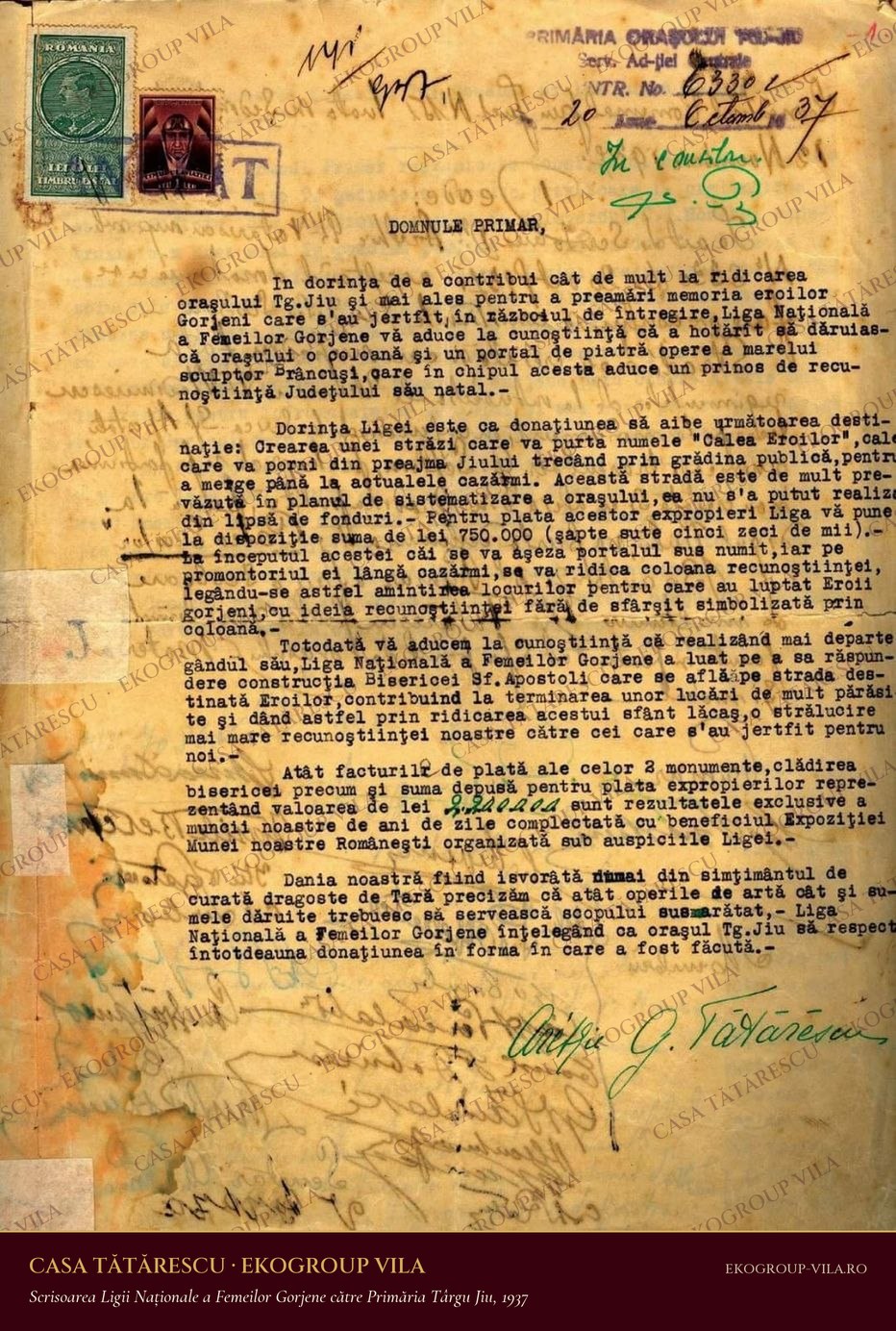
The letter is a single typewritten page, addressed “Mr Mayor” (“Domnule Primar”). The document shows:
- top left, two revenue stamps;
- top right, the stamp “Tg-Jiu Town Hall, Central Administration Service” (“Primăria orașului Tg-Jiu, Serv. Ad-ției Centrale”). The entry number, 6330, and the date, 20 October 1937, are filled in by hand;
- below it, a resolution in green ink, “In council” (“În consiliu”), followed by initials;
- at the bottom, the signature, also in green ink: Arethia G. Tătărescu.
The total amount of the donation is not typewritten. It was filled in by hand, in a space left blank in the text.
What the letter says
In short, the National League of Gorj Women informs the Târgu Jiu town hall that it:
- Gives the town two works by Brâncuși: “a column and a stone portal”, in memory of the Gorj heroes who fell in the “war of national unification”, that is, the First World War. The letter adds that the sculptor “brings a tribute of gratitude to his native County”.
- Sets a condition: a street named “Calea Eroilor” (the Heroes’ Way) must be opened, from the Jiu, through the public garden, to the barracks. The street had long been provided for in the town’s development plan, but had not been built for lack of money. For the expropriations, the League gives 750,000 lei.
- Sets the places of the monuments: the portal at the start of the way, the column “on its promontory near the barracks”. The column symbolises “the idea of gratitude without end”.
- Takes on the construction of the Church of the Holy Apostles, which stands on the same street, in order to finish “works long abandoned”.
- States where the money comes from: the invoices for the two monuments, the church building and the money for the expropriations come exclusively from the League’s work “over many years”. To this are added the proceeds of the exhibition “Our Romanian Work” (“Munca noastră românească”), organised under the League’s auspices.
- Asks for the donation to be respected: the works and the money must serve exactly the stated purpose, and the town must “always respect the donation in the form in which it was made”.
The letter mentions only the column and the portal. The Table of Silence, the third piece of today’s ensemble, does not appear in the document.
Full transcription
The transcription keeps the spelling and punctuation of the original. Letters we have added, where the typist made a mistake, are in square brackets. The handwritten amount is also in square brackets.
[De mână, în colț:] 141/937
[Ștampila:] PRIMĂRIA ORAȘULUI TG-JIU · Serv. Ad-ției Centrale · INTR. No. 6330 · 20 Octomb. [19]37
[Cerneală verde:] În consiliu [parafă]
DOMNULE PRIMAR,
In dorința de a contribui cât de mult la ridicarea orașului Tg.Jiu și mai ales pentru a preamări memoria eroilor Gorjeni care s'au jertfit în războiul de întregire, Liga Națională a Femeilor Gorjene vă aduce la cunoștiință că a hotărît să dăruiască orașului o coloană și un portal de piatră opere a marelui sculptor Brâncuși, care în chipul acesta aduce un prinos de recunoștiință Județului său natal.-
Dorința Ligei este ca donațiunea să aibe următoarea destinație: Crearea unei străzi care va purta numele "Calea Eroilor", cale care va porni din preajma Jiului trecând prin grădina publică, pentru a merge până la actualele cazărmi. Această stradă este de mult prevăzută în planul de sistematizare a orașului, ea nu s'a putut realiza din lipsă de fonduri.- Pentru plata acestor expropieri Liga vă pune la dispoziție suma de lei 750.000 (șapte sute cinci zeci de mii).- La începutul acestei căi se va așeza portalul sus numit, iar pe promontoriul ei lângă cazărmi, se va ridica coloana recunoștiinței, legându-se astfel amintirea locurilor pentru care au luptat Eroii gorjeni, cu ideia recunoștiinței fără de sfârșit simbolizată prin coloană.-
Totodată vă aducem la cunoștiință că realizând mai departe gândul său, Liga Națională a Femeilor Gorjene a luat pe a sa răspundere construcția Bisericii Sf.Apostoli care se află pe strada destinată Eroilor, contribuind la terminarea unor lu[cr]ări de mult părăsite și dând astfel prin ridicarea acestui sfânt lăcaș, o strălucire mai mare recunoștiinței noastre către cei care s'au jertfit pentru noi.-
Atât facturil[e] de plată ale celor 2 monumente, clădirea bisericei precum și suma depusă pentru plata expropierilor reprezentând valoarea de lei [2.200.000, completat de mână] sunt rezultatele exclusive a muncii noastre de ani de zile completată cu beneficiul Expoziției Mun[c]ii noastre Românești organizată sub auspiciile Ligei.-
Dania noastră fiind izvorâtă numai din simțimântul de curată dragoste de Țară precizăm că atât operile de artă cât și sumele dăruite trebuesc să servească scopului susarătat,- Liga Națională a Femeilor Gorjene înțelegând ca orașul Tg.Jiu să respect[e] întotdeauna donațiunea în forma în care a fost făcută.-
Arethia G. Tătărescu
English translation
[Handwritten, in the corner:] 141/937
[Stamp:] TG-JIU TOWN HALL · Central Administration Service · INCOMING No. 6330 · 20 Oct. [19]37
[Green ink:] In council [initials]
MR MAYOR,
Wishing to contribute as much as possible to the advancement of the town of Tg. Jiu, and above all to glorify the memory of the Gorj heroes who gave their lives in the war of national unification, the National League of Gorj Women informs you that it has decided to give the town a column and a stone portal, works of the great sculptor Brâncuși, who in this way brings a tribute of gratitude to his native County.
The League’s wish is that the donation should have the following purpose: the creation of a street that will bear the name “Calea Eroilor” [the Heroes’ Way], a way that will start near the Jiu and pass through the public garden, to reach the present barracks. This street has long been provided for in the town’s development plan; it could not be built for lack of funds. For the payment of these expropriations the League places at your disposal the sum of 750,000 lei (seven hundred and fifty thousand). At the beginning of this way the above-named portal will be placed, and on its promontory near the barracks the column of gratitude will be raised, thus linking the memory of the places for which the Gorj Heroes fought with the idea of gratitude without end symbolised by the column.
At the same time we inform you that, carrying its thought further, the National League of Gorj Women has taken upon itself the construction of the Church of the Holy Apostles, which stands on the street dedicated to the Heroes, contributing to the completion of works long abandoned and thus, through the raising of this holy place, giving greater splendour to our gratitude towards those who gave their lives for us.
The payment invoices for the 2 monuments, the church building and the sum deposited for the payment of the expropriations, amounting to [2,200,000, filled in by hand] lei, are the exclusive result of our work over many years, supplemented by the profit of the Exhibition of Our Romanian Work, organised under the auspices of the League.
As our gift springs solely from a feeling of pure love of Country, we state that both the works of art and the sums given must serve the purpose stated above, the National League of Gorj Women expecting the town of Tg. Jiu always to respect the donation in the form in which it was made.
Arethia G. Tătărescu
Context
The letter is one step on the road to the Târgu Jiu ensemble. The main moments:
| Date | Event |
|---|---|
| 1934 | Advised by the sculptor Milița Petrașcu, Arethia Tătărescu invites Constantin Brâncuși to create the monument to the Gorj heroes.1 |
| 11 February 1935 | Brâncuși accepts, in a letter to Milița Petrașcu: “I cannot tell you how happy I would be to be able to make something at home, in our Country”.2 |
| September 1937 | The column is cast at the Petroșani Central Workshops, under the direction of the engineer Ștefan Georgescu-Gorjan.1 |
| 20 October 1937 | The League’s letter is registered at the Târgu Jiu town hall, under number 6330.3 |
| 7 November 1937 | Patriarch Miron Cristea consecrates the Church of the Holy Apostles Peter and Paul on Calea Eroilor. Brâncuși is a guest of honour.4 |
| 12 November 1937 | The town council accepts the donation and the name “Calea Eroilor”, by decision no. 151.3 |
| 27 October 1938 | The League hands over to the town the “Column of Gratitude” and the “Portal”, and the ensemble is inaugurated.35 |
| 27 July 2024 | UNESCO inscribes the Brâncuși Monumental Ensemble of Târgu Jiu on the World Heritage List.6 |
By October 1938, expenditure had reached 2,436,275 lei:
| Item | Lei |
|---|---|
| The church | 666,462 |
| Expropriations | 746,000 |
| The portal | 683,198 |
| The column | 340,615 |
Most of the cost of the Column was borne by the “Petroșani” Company, and Brâncuși refused to be paid for the work.57
Where the original is kept. The letter is part of the records of the Târgu Jiu town hall, held at the State Archives in Târgu Jiu, file 41/1937, folio 45. The reference comes from Ion Mocioi, who published the document in 1971.8 On the back, according to the same sources, decision no. 151 of 12 November 1937 is written by hand.3
Transcriptions in circulation with errors. Some transcriptions published online misread the signatory’s name as “Aristița G. Tătărescu” and the registration number as “63301”.9 On the original, “Arethia G. Tătărescu” and “6330” can be read clearly. The “1” in the incorrect transcriptions is in fact the pen stroke after the number.
For the woman who signed the letter, see Arethia Tătărescu.
Using the image
The photograph of the document on this page bears the watermark Casa Tătărescu · EkoGroup Vila, and the source is also written in the file’s metadata. You may use it for articles, school work or studies. Please keep the watermark and credit the source, with a link to this page. You can use the code below:
<figure>
  <a href="https://ekogroup-vila.ro/en/history/arethia-tatarescu-letter-1937">
    <img src="https://ekogroup-vila.ro/assets/istorie/scrisoarea-arethia-tatarescu-primaria-targu-jiu-1937.jpg"
         alt="Arethia Tătărescu’s letter to the Târgu Jiu town hall, 1937" width="932" height="1384">
  </a>
  <figcaption>Source: Casa Tătărescu · EkoGroup Vila (ekogroup-vila.ro)</figcaption>
</figure>
For a higher-resolution version or for other uses, write to us.
Notes and sources
-
„#AnulBrâncuși: Ansamblul Monumental «Calea Eroilor» de la Târgu Jiu” [#BrâncușiYear: The “Calea Eroilor” Monumental Ensemble in Târgu Jiu], Agerpres, 19 May 2026. agerpres.ro ↩ ↩2
-
Sorin Buliga, „Ansamblul monumental de la Târgu Jiu” [The monumental ensemble at Târgu Jiu], Historia. historia.ro ↩
-
Sorin Buliga, „Donarea operelor brâncușiene Primăriei orașului Târgu Jiu de către Liga Națională a Femeilor Gorjene” [The donation of Brâncuși’s works to the Târgu Jiu town hall by the National League of Gorj Women], Gorjeanul, 13 February 2018. gorjeanul.ro ↩ ↩2 ↩3 ↩4
-
Monica Negru, study on Arethia Tătărescu, Orizonturi culturale, no. 10/2023. orizonturiculturale.ro ↩
-
„Despre Ansamblul Monumental Calea Eroilor din Târgu Jiu, la 83 de ani de la inaugurare” [On the Calea Eroilor Monumental Ensemble in Târgu Jiu, 83 years after its inauguration], UZPR, 27 October 2021. uzpr.ro ↩ ↩2
-
UNESCO, World Heritage Committee, decision 46 COM 8B.24 (New Delhi, 2024). whc.unesco.org ↩
-
„Sculptural Ensemble of Constantin Brâncuși at Târgu Jiu”, Wikipedia (English). en.wikipedia.org ↩
-
Ion Catană, „Arethia Tătărescu — un dar cultural neprețuit pentru Târgu Jiu” [Arethia Tătărescu — a priceless cultural gift for Târgu Jiu], Litua, XVIII, 2016 (with the facsimile of the letter; reference to Ion Mocioi, Brâncuși — ansamblul sculptural de la Târgu Jiu [Brâncuși — the sculptural ensemble at Târgu Jiu], 1971, p. 184). PDF, litua.ro ↩
-
„Ansamblul brâncușian din Târgu Jiu, semn al generozității Ligii Naționale a Femeilor Gorjene” [The Brâncuși ensemble in Târgu Jiu, a sign of the generosity of the National League of Gorj Women], Ziarul Lumina, 25 September 2016. ziarullumina.ro ↩
The people and the era of the Tătărescu House
- Biography Arethia Tătărescu The Great Lady of Gorj: the Gorj Women’s League, the commission to Brâncuși and the house on Polonă Street.
- Art Constantin Brâncuși and the Tătărescu family Arethia’s invitation, Milița Petrașcu’s role, the summers at Poiana and the letters lost in 1950.
- Art Milița Petrașcu The sculptor who worked in Brâncuși’s studio and made the fireplace in the house’s salon.
- Architecture The architects Alexandru Zaharia and Ion Giurgea The two architects of the house, which received its building permit in 1935, and the Mediterranean style of interwar Bucharest.
- Biography Gheorghe Tătărescu Twice Prime Minister of Romania, King Carol II’s trusted man, arrested in 1950.
- The era Carol II and interwar Bucharest Carol II’s reign, the Tătărescu government and the buildings that changed the capital in the 1930s.
- Mysteries The unopened safe of the Tătărescu House The Fichet safe in the Prime Minister’s study, closed for decades: what is known, what is legend, how to date it.
- The house The history of Vila Tătărescu From 1935, through nationalisation, to the restoration of 2024.
See the house for yourself
The Art. History. Experience. guided tour takes you through the salons where the Tătărescu family lived.