
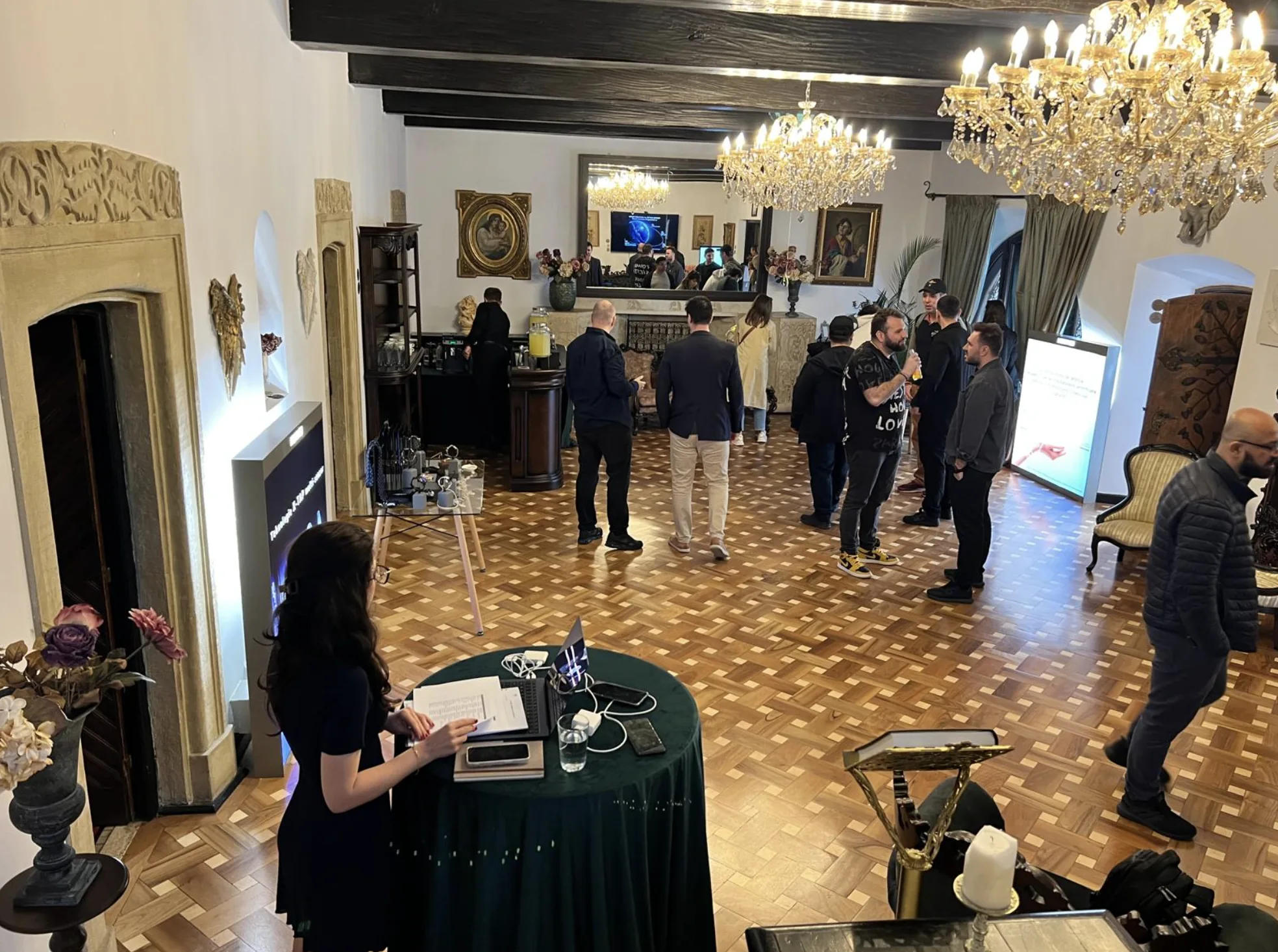
The venue is not just the setting of a corporate event: it fixes the format, the pace of the day and a good part of the logistics. The question “how do you choose a corporate event venue?” has a methodical answer, and the order of the steps matters more than a list of names gathered from recommendations. This guide is written for HR and marketing colleagues and for executive assistants, who take the decision from brief to signature.
How to choose a corporate event venue: the order of decisions
The most expensive mistake is to start from a room you liked and fit the event around it. The order that spares you compromises is the reverse:
- The objective. What should have changed in people’s minds by the time they leave: that they have understood a strategy, worked together, felt valued.
- The format. The objective translates into a seating arrangement: theatre-style, work tables, boardroom, seated dinner, standing reception or a combination.
- The realistic number of participants — not the guest list, but the attendance you expect.
- The fixed constraints: the date, access, the time slot, the internally approved budget.
- Only now the shortlist of venues and the site visits.
The budget stays in fourth place: a cheap room that forces you to hire a stage, a sound system and furniture usually ends up costing more than one that is already equipped. The tax treatment of the expense is not something to discuss with the venue — check with your accountant which documents you need.
Each format asks something different of the space
- Conference (theatre-style): a clear view of the screen from the back row, good acoustics, microphones, a place for registration.
- Workshop and training: work tables, natural light, the option of splitting the group into teams, breaks served close to the room.
- Board or VIP meeting: a closed room, discretion, access without passing through another event; a library such as the Premier’s Library, with 2–6 seats, works better than a large, half-empty room.
- Seated dinner: space between the tables for service and a short route to the catering prep area.
- Reception or cocktail party: free movement, several bar points, a few places to sit down.
- Launch or gala: two moments in the same evening, with a transition that does not move the guests to another place.
How many guests actually fit
Capacity is not a single figure but a figure per format: the same room takes far fewer people at tables than standing. When you ask for a quote, ask explicitly: “how many people, in format X?” As a benchmark for a building of this type: at Vila Tătărescu, a historic house in Bucharest, the same salons take 40 people theatre-style, 80 seated at tables and 100 at a cocktail reception, while the 800 m² courtyard goes up to 150 — the maximum for the house; board and VIP meetings, 10–20 people (the space for corporate events).
Then work out realistic attendance: some of those who confirm do not turn up, and at evening events the gap is usually bigger. Work with a cautious estimate, not with the guest list, and keep a comfortable margin between it and the maximum capacity for the format. A room filled to the limit looks good in photographs, but it is hard to breathe in.
Access, parking and the guest’s first minute
The event actually starts in the street. Check the real travel time at the hour of the event, not the daily average, and decide from the outset what happens with cars: the venue’s own car park, a nearby public car park or organised transport. Then ask about accessibility for people with reduced mobility, about the suppliers’ entrance and about the time from which set-up can begin, and finally ask for the number of toilets relative to the number of guests — the detail nobody asks about and everyone notices at the break.
Technical set-up: projection, sound, internet
Ask for the list of included equipment in writing, separate from the list of equipment hired as extras. You want to know which screens there are, whether the speaker’s laptop screen can be shared, how many wireless microphones are available, whether the internet is stable in all the spaces you will use — outside included — and who is responsible for the technical side on the day of the event. A dedicated event manager is worth more than a shelf of equipment with nobody standing next to it.
Acoustics and lighting
Acoustics and lighting are the two things you cannot see in photographs and can feel within the first few minutes. Ask to see the room empty and speak in a normal voice from the far end: if the echo sends your own words back to you, the conference will be tiring and the dinner noisy. Hard floors, high ceilings and bare walls increase reverberation; curtains, rugs and upholstered furniture soften it.
For lighting, ask what can be adjusted — intensity, colour temperature, spot lighting — and see the space at the time of your event, not at midday: a beautiful room that is lit evenly gives flat photographs.
Catering, bar and house rules
Three situations, three different negotiations: the venue has its own kitchen and service, works with a short list of approved suppliers, or accepts any supplier. None is better than the others, but each calls for different questions. It is worth clarifying in the quote who serves and in what form (buffet, table service, food stations), how special diets are covered, how the bar works and what happens when consumption goes above the estimate.
The house rules are worth clarifying in the first conversation: the sound level allowed after a certain hour, whether and how the space can be decorated, whether another event is taking place on the same day. Also ask whether the venue works on a private-event basis, with only one event at a time — it matters a great deal for confidential meetings.
The plan B for the weather
Any format with an outdoor element needs an alternative written into the contract, not a verbal promise. Three questions settle everything: where the event moves to, how many guests fit in the indoor option and by what time the decision can be made.
The second answer is where the surprises hide. At Vila Tătărescu, for example, the 800 m² courtyard takes 150 guests at a cocktail reception and the salons 100 — a difference you should find out before the invitations go out, not on the day of the event. If the indoor limit is below the confirmed number, cut the list, choose another venue or cover the courtyard.
How to request a quote
A good request gets comparable answers. Send every venue on your shortlist the same text: the date and time slot, the type of event, the estimated number of guests, the seating format, the hour-by-hour programme (set-up, arrival, session, meal, close), technical and catering needs, the reply deadline. The quote must state clearly what is included in the price, what is invoiced separately, what the cancellation and rescheduling policy is, and what deposit is required and when. Many venues of this kind do not publish rates but build the quote per event, “on request” — which is normal, as long as the final document is detailed.
What to ask at the site visit
Go with a list, ideally at the time your event will take place (you will find a sample room-by-room sheet in the overview of the spaces):
- What capacity does each room have, in the format you are interested in?
- Which way do guests move between moments, and where do crowds form?
- Where is the cloakroom and who staffs it?
- Who is the contact person on the day of the event, and on which number can they be reached?
The final checklist
The last filter before signing, to go through point by point:
- The objective of the event, written in one sentence
- The seating format, chosen according to the objective
- Capacity confirmed in writing, for the chosen format
- The date secured with a pre-contract or a deposit
- Access, parking and accessibility checked on site
- Included equipment, listed separately from hired equipment, and the internet tested
- Acoustics and lighting checked at the time of the event
- Menu, bar, special diets and extra consumption clarified
- A plan B for the weather, with indoor capacity and a decision deadline
- An hour-by-hour programme, with set-up and take-down included
- The contact person for the day of the event, with a phone number
- The cancellation and rescheduling policy, read in full
- The documents required for accounting, confirmed with your accountant
The right choice is not the most spectacular venue, but the one where your format fits naturally and where people do not have to make up for anything: not the acoustics, not the access, not the lack of a plan for rain.
If your shortlist is ready, see the formats the house takes and ask for a quote.