
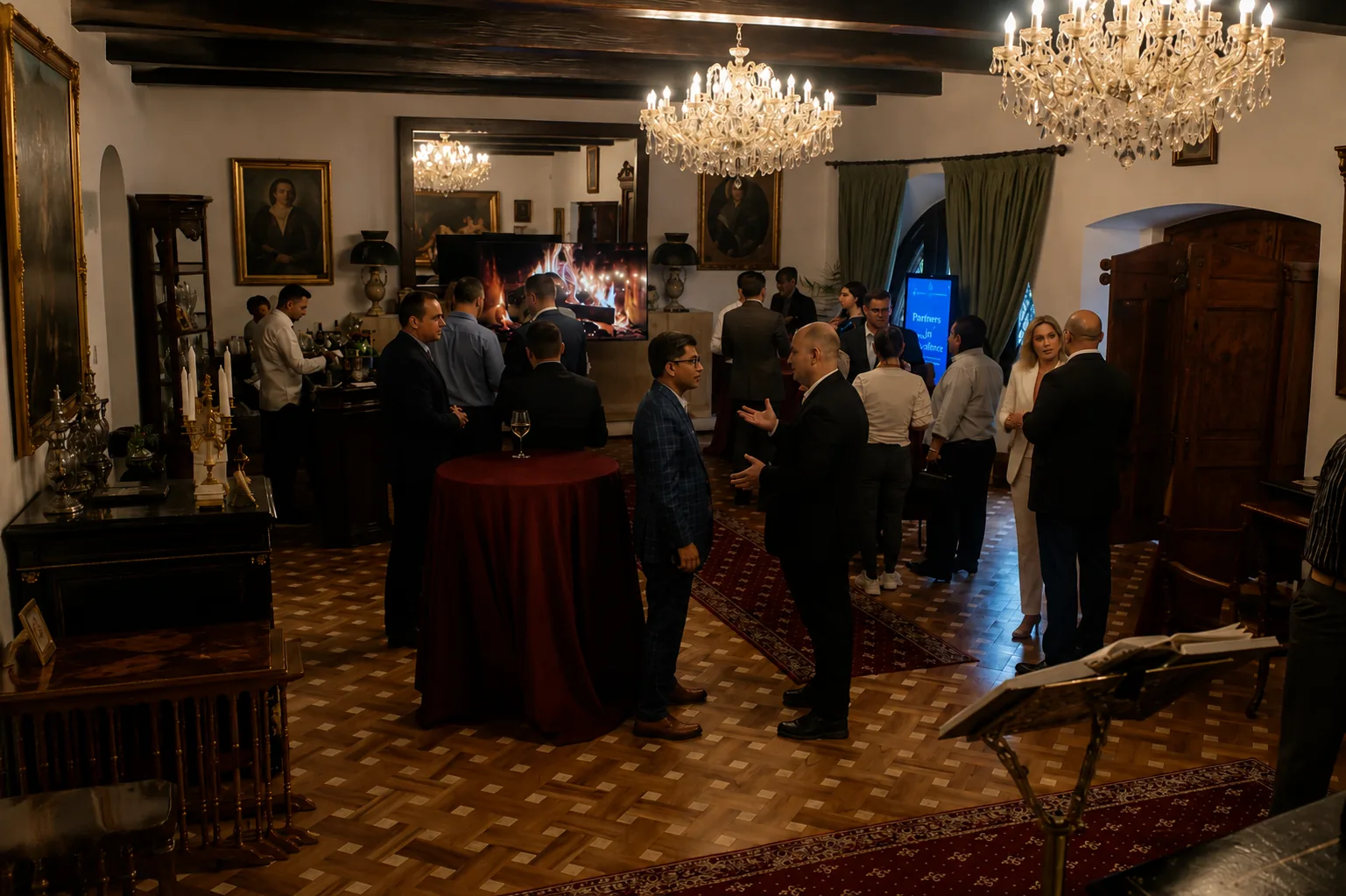
A company party is one of the few evenings when a company shows itself, not its product. “How do you organise a company party that stays elegant?” The answer depends less on the budget and more on the order of your decisions: no forced games, no microphone passed from hand to hand, no awkward moment after eleven o’clock. Below you will find the timeline, the choices that matter and what goes wrong most often.
How to organise a company party: the timeline by stage
There is no universal deadline, but the gaps between the stages are almost always the same. For an evening in December, move the whole timeline earlier: the end of the year is booked first.
- Three to four months before. Fix the date and the approximate number of guests. The date is chosen first; the venue is found around it. As a rule, a Tuesday or Thursday evening fits into people’s diaries more easily than a Friday.
- Two to three months before. Visit the venue in person, at the time the event will start, and choose the format: a seated dinner, a standing reception or a combination. This is also when the theme is decided.
- Six to eight weeks before. Send the invitation. Taste the menu. Book the photographer and the music — these are the suppliers whose diaries fill up fastest.
- One month before. Collect the replies and the dietary restrictions. Draw up the seating plan: at a dinner, the seating is half of the evening’s success.
- Two weeks before. Write the hour-by-hour programme, with the names of the speakers and the length of each speech, and confirm the technical equipment.
- In the final week. The final guest list, transport and a walk-through of the space with the person who coordinates the evening.
- The day after. A short thank-you message and the photographs, in a folder people actually open.
The financial side — budget per guest, contract, deposit, the tax treatment of the expense — is arranged in parallel and checked with your accountant, depending on the company’s situation.
The theme: a reference point, not a costume
A good theme needs no explaining to anyone: it sets the tone for the dress code, the music and the menu, then steps back. A bad one calls for wigs and props, and the next day it becomes an inside joke.
The safest reference point is the venue itself: an interwar house carries an evening in the spirit of the 1930s on its own, with no added décor. State the theme in the invitation in a single sentence and ask for the dress code clearly, not by hint: “evening dress” is an instruction; “elegant casual” is not.
Invitations go out early and complete
Announce the date as soon as it is certain, even if the other details are still missing. The invitation itself goes out later and always contains: the start time, the address with a landmark to help people find it, the format of the evening, the dress code, the deadline for replies and the person guests reply to. Add a question about dietary restrictions.
If you are also inviting partners, say so explicitly: ambiguity on this point causes more awkwardness than any other detail of the evening.
The menu: the service matters more than the list of dishes
Choose the format according to what you want to happen that evening. A seated dinner creates long but fixed conversations: each person talks to three or four people all evening. A standing reception keeps the group moving, but tires guests after about two hours. The combination — a short dinner, then leaving the table — reconciles the speeches with mixing between departments.
- Ask for a tasting before you sign: a menu read on paper tells you nothing about the temperature at which the food reaches the table.
- Agree in advance on vegetarian, fasting and gluten-free options, as dishes in their own right, not as “we’ll take the meat off the plate”.
- At a reception, calculate the canapés per hour, not per evening, and ask for service to continue during the speeches.
- The bar needs a non-alcoholic alternative that looks just as good in the glass: some of the guests are driving.
Music and noise
Noise is one of the reasons guests leave early. If two people sitting opposite each other have to raise their voices, the evening is over.
Keep background music throughout the meal — a piano, a string trio, a discreet set of recordings — and let the volume rise only after the speeches. If you bring in a DJ, agree in writing on the maximum level and the time from which it goes up. Acoustics matter too: wood and textiles sound warm; concrete and glass are tiring.
The pace of the evening: a single high point
A company party that works lasts about four hours and has a single high point.
- The welcome, about half an hour. A drink on arrival, a cloakroom, no programme. Let late arrivals get there.
- The speeches, ten minutes at most in total. Two speakers, not five. Specific thanks, not a review of results. Internal awards are presented here, not at midnight.
- The meal or main service, about an hour and a half.
- The free part. This is where you see the difference between a large hall and a house with several rooms: groups split up naturally, and anyone who wants quiet can find it. At Vila Tătărescu, the salons take 100 guests for a cocktail or 80 seated, the 800 m² courtyard takes up to 150 guests for a cocktail, and private experiences are held in groups of up to 12 (the spaces of the house).
- The close, announced. An end time communicated in advance is a gesture of respect, not a restriction.
Photography: what to ask the photographer
Hire a photographer and tell them in advance what you need: team portraits, a few wide shots, the moment of the speeches. Without a list, you will receive hundreds of photographs of people chewing.
Set aside ten minutes, in good light, for the group photograph: it is the image you will use most often in the months that follow. Announce if you are filming, and anyone who does not want to appear can say so at the entrance.
Transport and guests leaving
The departure leaves the last impression, and it is the part everyone forgets.
- Check the parking in advance: how many spaces there are and what the nearby alternative is. Put the answer in the invitation.
- For a central venue, encourage taxis; for one on the edge of the city, organised transport is not an optional extra but a necessity.
- Twenty minutes before the announced time, ask the bar for last orders.
- Appoint one person who stays until the end, looks after the cloakroom and checks that every guest has a way to get home.
What usually goes wrong
- The date is chosen too late. In November and December demand for venues rises, so fix the date well in advance.
- The programme gets overloaded. Five entertainment acts, a quiz and a raffle make an evening in which no one gets a chance to talk.
- The speeches run long. Twenty minutes at the microphone cancel out two hours of organisation.
- The music goes up too early, and those who wanted to talk leave before dessert.
- There is no single person in charge who says when food is served, when people speak and when the lights come on.
- There is no plan B for the courtyard. Any outdoor event needs an indoor option decided in advance.
What to ask the venue before you sign
Five questions separate a serious venue from one that improvises:
- Is only one event held at a time, or several in parallel?
- Who coordinates on the evening?
- What does the technical equipment include?
- How many toilets and how many parking spaces are there?
- Until what time can there be noise?
At Vila Tătărescu, the house authorised in 1935 for the family of Prime Minister Gheorghe Tătărescu, the answer to the first question is that it works as a private-event venue: one event at a time, with a dedicated event manager, 4K audio-video with wireless microphones, premium catering and a bar, six toilets; the villa has no private parking, and guests park on the street, in the public spaces in the area. The formats are set out on the corporate events page, and prices are given on request: the quote depends on the date, the format and the number of guests.
The elegance of a company party does not come from the budget, but from three decisions: an evening with a single high point, a volume at which people can talk, and an organised departure. The rest shows in the photographs. For a specific format, you can write to us through the contact page.
Company parties are held in the salons and the 800 sqm courtyard, up to 150 guests.