
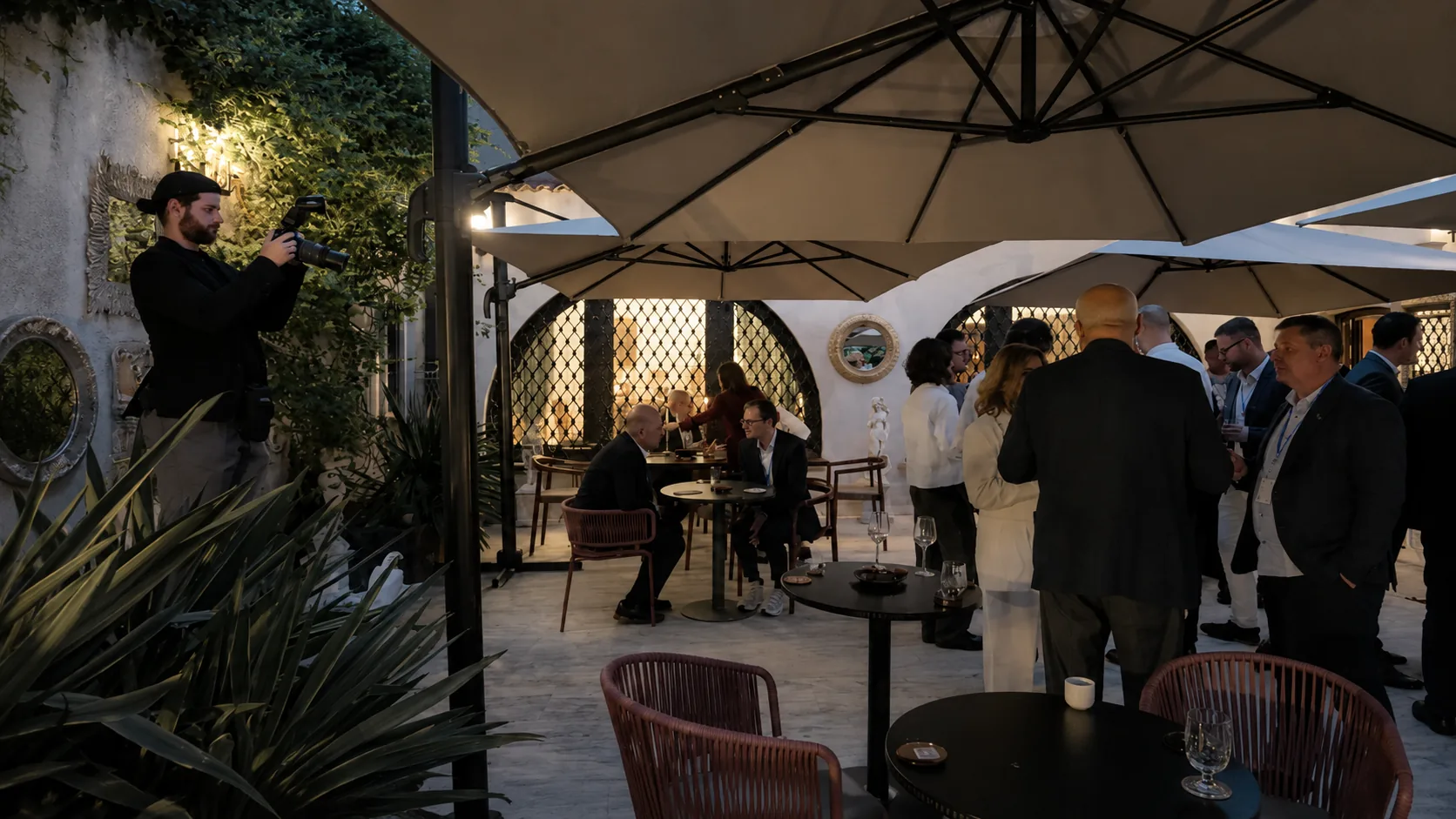
An event in a historic monument in Bucharest is prepared differently from one in a modern venue: here the building has the first say, and the plan is built around it, not the other way round. The difference is not about protocol but about very concrete details, from the way a banner is fixed to where the loudspeakers stand. Below are the practices found in most listed houses, so that you arrive at your first visit with the right questions.
What a listed building means for an organiser
Listing protects the building and its historic features; exactly what is protected depends on the regime of each monument, and the host team can tell you what this means for that particular house. For you, the consequence is easy to state and hard to respect under the pressure of a set-up: in a listed building, nothing is improvised. What can be fixed, what can be moved and which way heavy equipment comes in are things you agree with the venue team, who know their house. The specific rules differ from building to building, so do not start from what you were allowed elsewhere.
Treat the first conversation as a working meeting, not a site visit. Ask from the outset for:
- the floor plan of the spaces, with the capacity of each room by format (theatre, seated, cocktail);
- what can and cannot be fixed to the walls, the joinery and the ceiling;
- which electrical circuits are available, and exactly where;
- the set-up and take-down windows, with exact times;
- who coordinates on the host's side on the day of the event;
- whether another event is taking place in the building on the same day.
The last question changes a lot: a house that hosts one event at a time gives you set-up time and quiet; an overlapping schedule gives you last-minute compromises.
Finishes and original features
The parquet, the stucco work, the carved wood, the door and window surrounds and the fireplaces are the reason you chose the building and, at the same time, the most vulnerable part of the evening. At Vila Tătărescu, for example, the salon fireplace is the work of the sculptor Milița Petrașcu, a pupil of Brâncuși: it is not a decorative object that can be moved aside, but part of the building.
The rules that are easy to follow are mundane, and that is exactly why they get forgotten:
- protection under the legs of tables, the stage and any heavy structure;
- an agreed route for carrying equipment, protected along its entire length;
- moving furniture and heritage objects left to the venue staff, not to your suppliers — confirm this rule at the first visit;
- candles, open flames and stage smoke discussed explicitly, before they go into the cost estimate;
- a joint check before set-up and another after take-down, with both parties present.
Set-up, branding and decor
Branding is where an agency's requirements most often collide with the reality of a monument house. Adhesive on the walls, nails in the joinery and fixings in the ceiling are, as a rule, not allowed. The solutions that get approved are free-standing: a self-supporting frame for the backdrop, flags on bases, propped panels, reception tables with the graphics on them, projection where the surface allows it.
Discuss the small things early as well: the actual dimensions of each piece (a four-metre structure does not fit through every door), the route for deliveries and a place for packaging. Some buildings supply the decor themselves, from their own collection: then a good part of the set-up disappears from the plan.
Lighting and sound suited to the house
A room with high ceilings, plastered walls and a lot of wood sounds completely different from a conference room. Instead of two powerful loudspeakers, ask for a spread of small sources, placed low, at moderate volumes; speeches work best on wireless microphones, and presentations on screens with screen sharing, if the host has them. Check the power available on the circuits in advance, so that you do not discover on the day of the event that the band and the kitchen are on the same fuse.
With lighting, the principle is the same: the building already has a warm light, which you add to rather than cover up. Fixtures go on their own stands and are not hung from historic features. If the evening continues in the courtyard, ask until what time music can be played outside.
Guest flow
In a house built as a home, the rooms lead into one another, the staircases are narrow and the courtyard opens directly from the salons. Draw the complete route on the plan: arrival and parking, reception, cloakroom, main room, tables, toilets, smoking area, exit.
The number of toilets relative to the number of guests matters more than it seems: a building with six copes with a reception for 100 people quite differently from one with two. The second detail is access for guests with reduced mobility, where thresholds, steps and gravel have to be checked on site. Signage is kept discreet, with pieces placed on the tables, not banners on the façade.
Photography and filming
Historic houses photograph well, but not at every hour. Schedule a reconnaissance visit with the photographer and the video team at the time the event starts, so that you can see how the natural light falls. Agree with the host where the stands can go, how cables are handled along the guest route and whether drones are allowed. For photo shoots and commercial filming, many houses have terms separate from those for events, so ask for them early; the venue's gallery gives you a first idea of how the rooms look in photographs.
How many guests actually fit
In a historic house there is no single capacity figure, but one for each format and each room: the same room holds far more people standing than seated at tables, and a courtyard can exceed anything that can be done indoors.
As a concrete reference, the official capacities of Vila Tătărescu are: 40 people theatre-style or in conference format, 80 seated at tables, 100 for a cocktail reception in the salons and 150 for a cocktail reception in the 800 m² courtyard. Smaller formats have their own figures: 10–20 people for board meetings and VIP events, 2–6 for board meetings in the Premier's Library, 12 for private experiences. The house's maximum remains 150 guests, and the breakdown by room is shown on the spaces page.
Always ask for the figure per format, not the “maximum capacity”. A seated dinner for 100 people in a building advertised as holding “up to 150” is often impossible.
Budget, quote and contract
Historic venues usually give their prices on request, because the quote is built around the event: date, format, number of guests, menu, duration. Ask what the amount includes and what is invoiced separately, who is liable for damage, and what the terms are for cancelling or moving the date. For the tax treatment of the costs, check with your accountant.
What you gain from an event in a historic monument in Bucharest
All the constraints above pay off in a single currency: the setting. A building with a history works for you on both the staging and the conversation, and the event is remembered for the place where it happened.
Vila Tătărescu is a ready example: the building permit for the house was issued in 1935 for the family of Gheorghe Tătărescu, Prime Minister of Romania from 1934 to 1937 and again from 1939 to 1940. It is a listed historic monument, LMI code B-II-m-B-19435, and the usual formats — conference, dinner, launch, board meeting — are translated here into the rooms of a home; how that translation looks for a company event is shown on the corporate events page.
Before your first visit
- The capacity of each room for each format, not just the building's maximum.
- What can be fixed, where, and with which systems.
- How many hours of set-up and take-down are included in the booking.
- Whether your event is the only one in the building that day.
- Toilets, parking, access for reduced mobility and a back-up plan in case of rain.
With these questions in hand, the first visit ends with a realistic plan. The rest — the atmosphere, the story of the house, the light at seven in the evening — is not something you organise; it is something you receive.
The house is a listed monument, LMI B-II-m-B-19435, and works on a private-event basis.